From Bone to Cloud: The Story of Data
Data refers to facts that are ‘given’
"Data” author Dan Heath reminds us “are just summaries of thousands of stories.” And data itself has a fascinating story behind it
Those of us who were in schools before the turn of the century, were taught that ‘data’ was plural for ‘datum’ which referred to a single piece of information. The root word, in fact, was the Latin verb ‘datum,’ whose origins go back to the 17th century. Interestingly, in the 1640s, when the word is stated to have made its first appearance, it was defined to mean ‘a fact given or granted.’. Data indeed is a ‘given’ and it is unimpeachable and cannot be questioned. In that is the origin of the power of data!
Ishango Bone – The ancient data storage tool
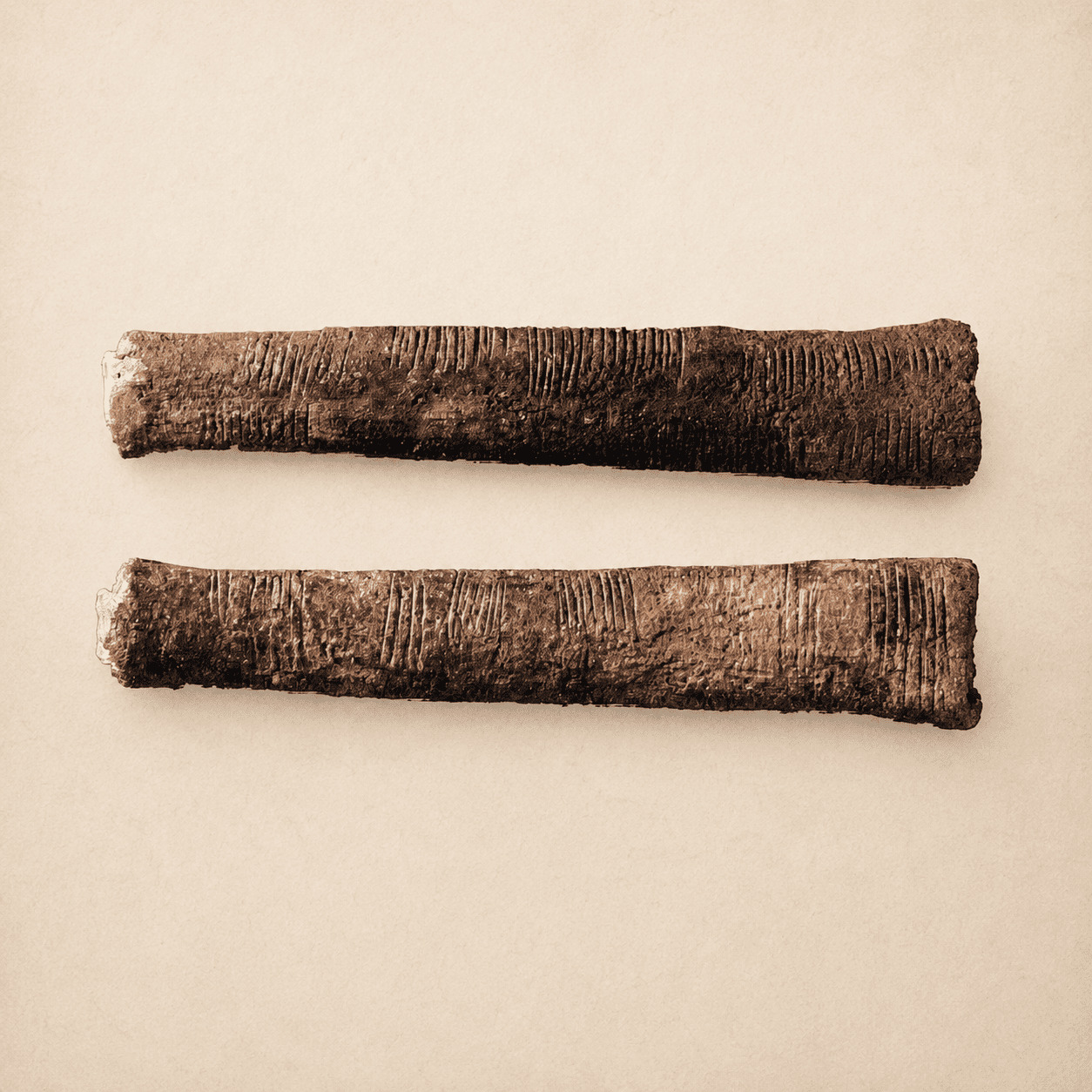
Today, we associate ‘data’ immediately with information technology, research and business. But human beings have been gathering data since the dawn of time. But the Ishango Bone (seen in the picture) is regarded as possibly oldest known data recording artefact. Unearthed in Congo, Africa in 1950, the Mathematical Association of America (MAA) cites research that dates it back to approximately 20,000 – 25,000 years ago. MAA describes the bone as probably the fibula of a baboon, large cat, or other large mammal which bears a series of organized notches readily making it look like tally stick.
Because the markings are highly deliberate rather than random, researchers generally classify the bone as a prehistoric calculator, data storage tool, or early record-keeping system. However, as people started living in human colonies and societies evolved, the need for recording and storage of data became more demanding.
Advances Inspired by a Hatmaker and a Punch Card Designer
Two significant milestones brought us closer to where we are today in recording, storing, retrieving and using data
Somewhere in the 1600s, John Graunt, a hatmaker and haberdasher in London, began gathering information regarding deaths in London in the wake of an epidemic. He made a record of details such as number of deaths, mortality rate among age groups and causes of death. He demonstrated that data could be used in understanding problems and designing solutions for them. This earned him an enduring place in the history of both statistics and data science
The next big leap in the story, came in 1884 when Herman Hollerith invented the punch card tabulating machine, inspired by devices that train conductors and silk weavers. Hollerith’s contraption made it possible to process and analyse large amounts of data in one go. The proof of concept came in a US population census of late 1800s when Hollerith’s device cut down data processing time from what used to take a full 10 years to just 3 months
Storage, Processing and Networking Leaps
From thereon, three developments paved the way for current day data associated technologies:
- In 1928, Fritz Pfleumer created and patented magnetic tapes that could store data. This dramatically enlarged the volume and safety of the data that was stored. Floppies and hard disk devices quickly followed, building on what was learnt from magnetic tapes
- 1960s witnessed the British computer scientist Edgar Codd invented the relational model for database management, that stored data in tables by describing the data attributes in rows and columns This laid the foundation for relational databases and relational database management systems
- The arrival of internet revolutionised data storage and sharing. Through Sir Tim Berners Lee’s, hypertext and hyperlinks connecting databases and sharing information became effortless
Artificial intelligence has emerged as the new driver of data growth, with systems continuously generating, processing, and working on vast datasets. Estimates indicate that the world currently generates around 400 to 460 million terabytes every day. Most laptops today come with 1 terabyte of storage. The world, therefore, creates 400 – 460 million laptops worth data on a daily basis. That’s how data-rich humanity is at present. And sales, the equivalent of human heartbeat of every business, is one of the domains that’s best placed to leverage it for economic growth and prosperity
"Without data, you're just another person with an opinion."
— W. Edwards Deming, American Business Theorist & Management Thinker