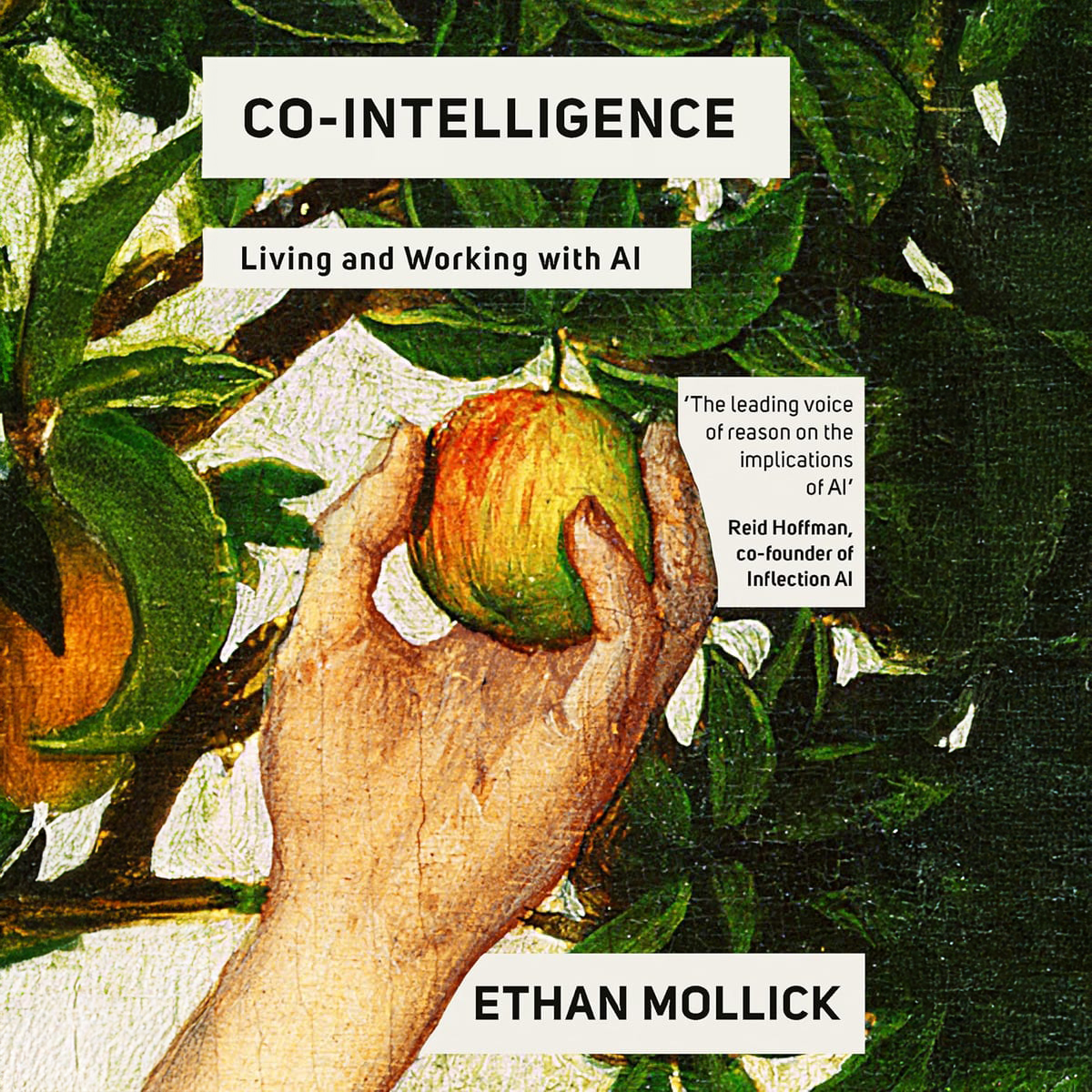
Co-Intelligence by Ethan Mollick
Co-Intelligence (2024) by Prof Ethan Mollick of Wharton School of the University of Pennsylvania, explores how we can partner with generative, language-based AI in any area of life or work that you want to excel in. The book touches upon both the possibilities and limitations that AI comes with and encourages you in simple, engaging language to live, work and thrive with AI
Below are select quotes and excerpts from the book’s chapter on “Four Rules for Co-Intelligence.” The core idea of the book is to treat AI as something that will augment our own natural intelligence. From this perspective, AI can be seen as Additional Intelligence
These four rules are especially valuable as road signs for all of us in business and professions to navigate the mystifying yet magical world of AI in our efforts to make the most of it
Four Rules for Co-Intelligence
“The fact is that we live in a world with AIs, and that means we need to understand how to work with them. So we need to establish some ground rules. Because the AI available to you when you read this book is likely different from the one I have when writing it, I want to consider general principles. We will focus on things inherent and timeless, as much as that is possible, in all current generative AI systems based on Large Language Models.
Here are my four principles of working with AI:
Principle 1: Always invite AI to the table.
You should try inviting AI to help you in everything you do, barring legal or ethical barriers. As you experiment, you may find that AI help can be satisfying, or frustrating, or useless, or unnerving. But you aren’t just doing this for help alone; familiarizing yourself with AI’s capabilities allows you to better understand how it can assist you—or threaten you and your job. Given that AI is a General-Purpose Technology, there is no single manual or instruction book that you can refer to in order to understand its value and its limits.
Principle 2: Be the human in the loop
For now, AI works best with human help, and you want to be that helpful human. As AI gets more capable and requires less human help—you still want to be that human. So, the second principle is to learn to be the human in the loop …
You provide crucial oversight, offering your unique perspective, critical thinking skills, and ethical considerations. This collaboration leads to better results and keeps you engaged with the AI process, preventing overreliance and complacency. Being in the loop helps you maintain and sharpen your skills, as you actively learn from the AI and adapt to new ways of thinking and problem-solving. It also helps you form a working co-intelligence with the AI.
Principle 3: Treat AI like a person (but tell it what kind of person it is).
….. To make the most of this relationship, you must establish a clear and specific AI persona, defining who the AI is and what problems it should tackle. Remember that LLMs work by predicting the next word, or part of a word, that would come after your prompt. Then they continue to add language from there, again predicting which word will come next.
So the default output of many of these models can sound very generic, since they tend to follow similar patterns common in the written documents the AI was trained on. By breaking the pattern, you can get much more useful and interesting outputs. The easiest way to do that is to provide context and constraints. It can help to tell the system “who” it is, because that gives it a perspective. Telling it to act as a teacher of MBA students will result in a different output than if you ask it to act as a circus clown.
Principle 4: Assume this is the worst AI you will ever use.
As AI becomes increasingly capable of performing tasks once thought to be exclusively human, we’ll need to grapple with the awe and excitement of living with increasingly powerful alien co-intelligences—and the anxiety and loss they’ll also cause. Many things that once seemed exclusively human will be able to be done by AI. So, by embracing this principle, you can view AI’s limitations as transient, and remaining open to new developments will help you adapt to change, embrace new technologies, and remain competitive in a fast-paced business landscape driven by exponential advances in AI”
About the Author
Ethan Mollick is the Ralph J. Roberts Distinguished Faculty Scholar, Rowan Fellow, and Associate Professor at the Wharton School of the University of Pennsylvania, where he studies the effects of artificial intelligence on work, entrepreneurship, and education. His academic research has been published in leading journals, and his work on AI is widely applied, leading him to be named one of TIME Magazine’s Most Influential People in Artificial Intelligence.
“Our intelligence is what makes us human, and AI is an extension of that quality.”
— Yann LeCun, Professor, New York University